What Is a Digital Exposure Assessment — and Why Family Offices Need One</span>
Daniel Lai Daniel Lai

What Is a Digital Exposure Assessment — and Why Family Offices Need One

What Is a Digital Exposure Assessment — and Why Family Offices Need One

If someone wanted to find your family, how long would it take them?

That is not a rhetorical question. It is the first question we ask when we begin a digital exposure assessment, and the answer is almost always shorter than the client expects. A home address sitting in an old company filing. Children's school uniforms visible in a tagged holiday photo. A property purchase reported in a trade publication. A staff member's social media post that places the family in a specific city on a specific date. None of these details feels dangerous on its own. Together, they form a map — and the people drawing that map are rarely well-intentioned.

What a digital exposure assessment actually is

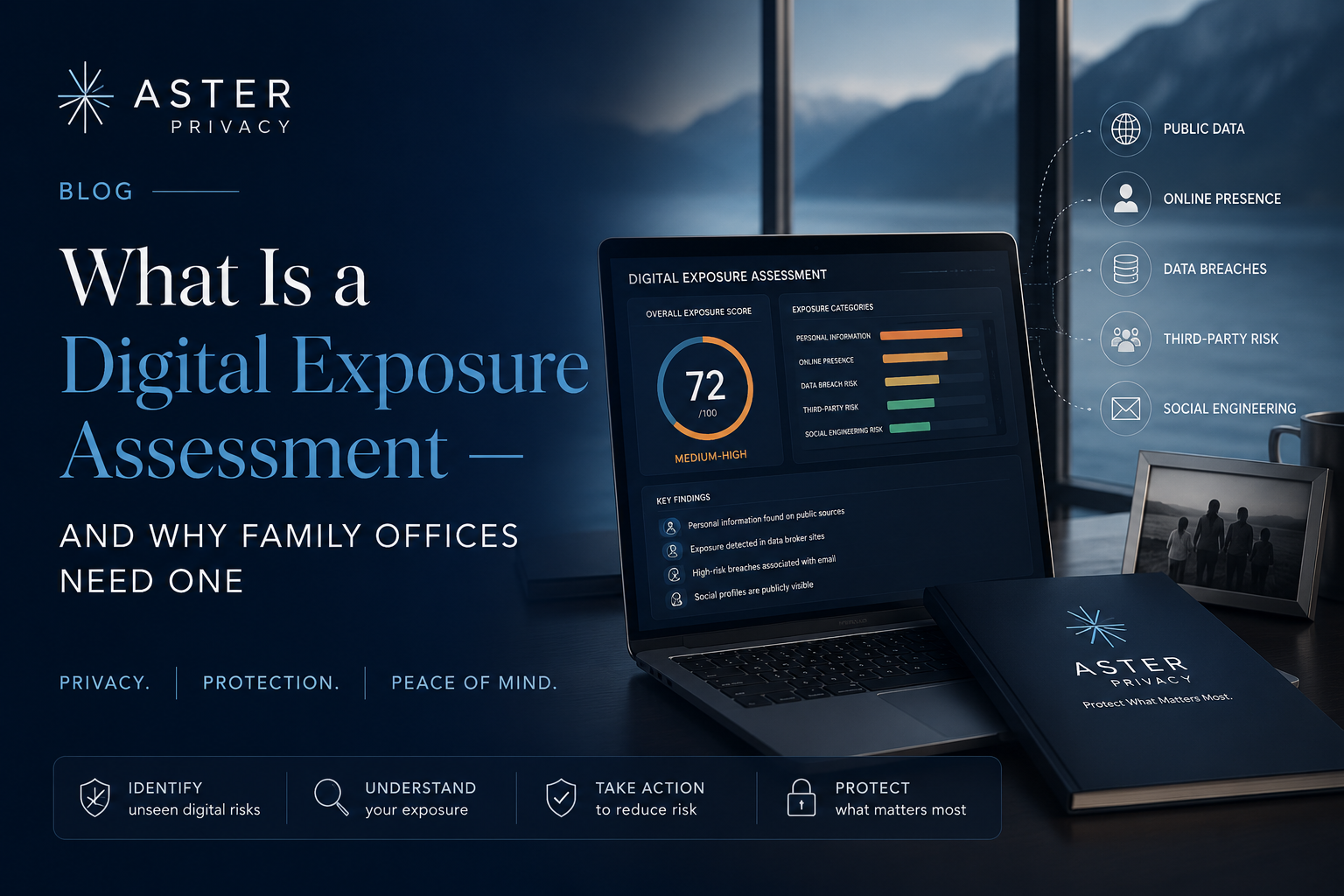
A digital exposure assessment is a structured investigation into what the outside world can learn about you, your family, and your office — using only information that is already publicly available or quietly circulating in places most people never look.

Put simply, we do what a motivated adversary would do, before they do it. That means examining:

  • The open internet. News coverage, corporate registries, court records, property records, conference appearances, and the long tail of old content that never gets deleted.

  • Social media — yours and everyone around you. Principals are often careful. Their adult children, household staff, drivers, and personal assistants frequently are not. A family's exposure is the sum of everyone in its orbit.

  • Breach ecosystems. Personal details — phone numbers, email addresses, past residences — are bought, sold, and leaked constantly. We identify what is out there and where it came from.

  • Platforms outside the Western internet. For families with business interests, relatives, or public profiles in Asia, a meaningful share of exposure lives on Chinese-language platforms such as WeChat, Xiaohongshu, Douyin, and Weibo. These are effectively invisible to standard Western monitoring tools, yet they are exactly where discussion about prominent individuals in the region takes place.

The result is not a pile of screenshots. It is a clear, prioritised report: here is what is exposed, here is how an adversary could use it, and here is what to fix first. At Aster Privacy we describe this in three words: map, measure, mitigate.

Why family offices, specifically?

Family offices sit in an uncomfortable position: they manage institutional levels of wealth with the security posture of a small business. Criminals have noticed. Deloitte's global research found that 43% of family offices experienced a cyberattack in the preceding 12–24 months, with a quarter suffering three or more attacks — and among offices managing over US$1 billion, the figure rises to 62%. A separate survey by AlTi Tiedemann Global and Campden Wealth found that around 70% of family offices now rank cybersecurity as their top operational risk.

Here is the detail that matters most: phishing was by far the most common form of attack, experienced by 93% of victims. Phishing is not a technology problem. It is an information problem. A convincing phishing message — or a deepfake voice call impersonating a principal — only works because the attacker already knows names, roles, relationships, travel patterns, and writing styles. All of that comes from exposed information. Firewalls and antivirus software do nothing about it.

And the risk is not only financial. Exposed information feeds harassment, extortion attempts, hostile media, activist targeting, and — at the most serious end — physical security threats to family members. The pattern is consistent: the incident happens online or in person, but the preparation happens in public data, often months earlier.

What you actually get from it

A good assessment leaves a family office with three things. First, an honest, evidence-based picture of exposure — not a generic checklist, but findings specific to your family, staff, and structures. Second, a prioritised remediation plan: data broker removals, takedown requests, privacy setting corrections, staff guidance, and changes to how the office handles information going forward. Third, a baseline — because exposure is not static, and what is clean today can resurface tomorrow.

You cannot protect what you have not measured. For most family offices, a digital exposure assessment is the single most clarifying step they can take: it replaces a vague sense of unease with a concrete list of problems, ranked by risk, each with a fix.

If you would like to understand what your family's map currently looks like, we should talk before someone else draws it.

Aster Privacy is a Singapore-based digital risk and protective intelligence firm serving family offices, principals, and high-visibility executives across Asia and beyond. Contact: contact@asterprivacy.com

Sources: Deloitte Private, The Family Office Cybersecurity Report 2024 (The Family Office Insights Series – Global Edition); AlTi Tiedemann Global & Campden Wealth, family office cybersecurity survey, 2025.

Read More